Historic Monuments of Dengfeng in the Center of Heaven and Earth
Overview
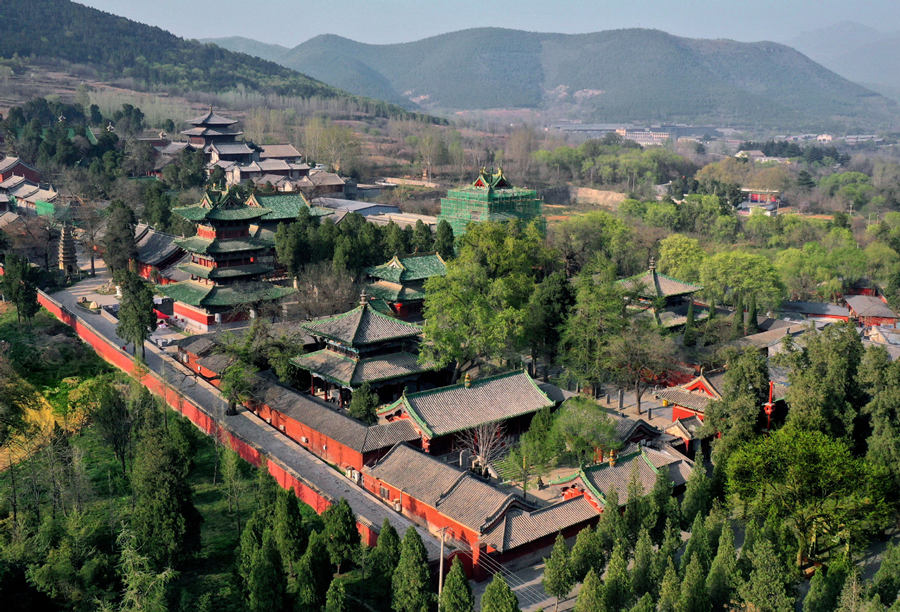
The Historic Monuments of Dengfeng in "The Center of Heaven and Earth" are a collection of ancient sites and structures located around the Songshan Mountain in Dengfeng, Henan province, China. This UNESCO World Heritage site encompasses a unique ensemble of eight clusters of buildings and sites, spread over a 40-square-kilometer area, which includes the remains of the oldest religious edifices in China, such as the Zhongyue Temple, Zhougong Sundial Platform, and the Dengfeng Observatory. These historic monuments are considered some of the finest examples of ancient Chinese architecture dedicated to ritual, science, technology, and education.
Situated in the heart of China, Songshan Mountain is regarded as the central sacred mountain, drawing disciples of Confucianism, Buddhism, and Taoism over centuries to advance their religious cultures. The area served as a political and cultural center during many dynasties, earning the title "The Center of Heaven and Earth." The historical significance and architectural grandeur of Dengfeng's monuments led to their inclusion on the UNESCO World Heritage list on August 1, 2010.
Notable structures within this site include the Songyang Academy, one of the oldest academies in ancient China; the 1,500-year-old Pagoda of Songyue Temple; and three pairs of ancient towers, Taishi, Shaoshi, and Qimu, built during the Han Dynasty (206 BC-220). These buildings reflect the diverse ways people have perceived and revered the center of heaven and earth, as well as the power of the mountain as a central point for religious devotion.
Historical Significance
The Historic Monuments of Dengfeng are deeply entrenched in Chinese history and culture, serving as a testament to the nation's ancient practices and beliefs. These structures were constructed over the course of nine dynasties, illustrating a rich tapestry of historical development in traditional Chinese architecture, science, and education. The monuments have played a pivotal role in maintaining the cultural and spiritual legacy of the region, which was once considered the center of ancient China.
The site's historical significance is also linked to its role as a hub for Confucianism, Buddhism, and Taoism. Over the centuries, Dengfeng has drawn religious scholars and practitioners from various backgrounds, becoming a melting pot of spiritual thought and practice. This enduring religious and cultural heritage is embodied in the monuments themselves, which have served as centers for learning and worship.
Additionally, the architectural and technological achievements of the Dengfeng monuments highlight the advanced understanding of astronomy, ritual, and education in ancient China. For example, the Dengfeng Observatory and Zhougong Sundial Platform showcase the scientific ingenuity of the time, with their precise instruments for celestial observation and timekeeping. These technological marvels not only reflect the intellectual advancements of the period but also underscore the importance of astronomy in ancient Chinese culture.
Zhongyue Temple
The Zhongyue Temple is a revered Taoist temple located at the foot of Huanggai Peak on Songshan Mountain in Dengfeng county, Henan province. It stands as the most complete and expansive Taoist architectural complex in China, with a storied history dating back to the 3rd century BC. The temple is significant for its well-preserved historical structures and its status as a key national temple of Taoism, drawing visitors and worshippers alike.
The temple's importance grew significantly after Empress Wu Zetian visited in 688 AD for worship, leading to a period of flourishing and expansion. By 1013, the temple complex had grown to encompass 900 rooms across various buildings. However, it experienced some decline over the ensuing centuries. Today, the temple covers an area of 100,000 square meters, with over 400 rooms remaining. The complex is notable for its architectural grandeur, particularly the Zhonghua Gate and Tianzhong Pavilion, which span 6,500 meters from south to north.
Among the temple's treasures are numerous cultural relics, including an extensive collection of inscriptions on tablets that are valuable for calligraphic research. The Main Hall, the principal building of the temple, is renowned for its intricate craftsmanship and stands as the most majestic structure within the complex. The Zhongyue Temple continues to attract approximately 1.5 million visitors annually, serving as a testament to its enduring cultural and spiritual significance.
Zhougong Sundial Platform
The Zhougong Sundial Platform is an ancient astronomical site located within the Historic Monuments of Dengfeng. This platform is historically significant as it represents the advanced scientific pursuits of ancient Chinese civilization. The site was used for astronomical observations and timekeeping, showcasing the technical ingenuity of its creators.
The sundial platform played a crucial role in the development of Chinese astronomy, providing a means to measure the shadow cast by the sun and thus determine time with precision. Such observations were pivotal for both practical purposes, such as calendar creation and agricultural planning, and for the cultural and philosophical importance attributed to celestial phenomena in Chinese culture.
The structure of the sundial platform and its design reflect the sophistication of ancient Chinese scientific knowledge. These innovations highlight the intellectual achievements of the period and underscore the importance placed on understanding celestial events. The Zhougong Sundial Platform remains an essential part of the cultural heritage of the region, symbolizing the historical contributions of China to the field of astronomy.
Dengfeng Observatory
The Dengfeng Observatory is the largest ancient observatory in China, located in Gaocheng town, southeast of Dengfeng. Constructed in 1276 AD during the Yuan Dynasty (1271-1368) by the astronomers Guo Shoujing and Wang Xun, the observatory was one of 27 observation stations established across China. This site is renowned for its historical significance and its contributions to the scientific research of the era.
The observatory, made from masonry, features a unique design that incorporates a stone gnomon, used for measuring the sun's shadow, and architectural elements that facilitate celestial observation. It stands at 12.62 meters in height, with a square base that narrows as it rises. The northern wall has a hollow groove, allowing for the placement of a higher gnomon that, in conjunction with the stone gnomon at the bottom, forms a sophisticated apparatus for shadow measurement.
The observatory's construction reflects the advanced understanding of astronomy in ancient China, with features such as two parallel watercourses and sumps with scales for measuring levelness, which aided in accurate timekeeping and celestial observation. Listed among the Key Cultural Relics under State Protection in 1961, the Dengfeng Observatory is an invaluable part of China's scientific heritage and a significant testament to the country's historical advancements in astronomical research.
Shaolin Temple
Shaolin Temple is one of the most renowned and historically significant religious sites located in the dense forested slopes of Songshan Mountain. It is particularly famous for its association with Chinese martial arts, especially Shaolin Kung Fu, and Zen Buddhism. Founded in the late 5th century, the temple became a center for Buddhist training and martial arts practice, attracting monks and martial artists from all over the region.
The temple complex, with its traditional Chinese architectural style, consists of various halls, pagodas, and natural landscapes, offering a serene environment for spiritual practice and martial arts training. The temple's architectural highlights include the Hall of Heavenly Kings, the Mahavira Hall, and the Pagoda Forest, which comprises numerous stone pagodas that serve as memorials to deceased monks. These structures not only reflect the religious and cultural significance of the Shaolin Temple but also showcase the architectural finesse of ancient Chinese builders.
The Shaolin Temple served as a major hub for the diffusion of Buddhism in China and beyond, and its martial arts tradition has had a profound impact on various forms of martial arts practiced globally. The temple's integration of martial arts and Buddhist practice highlights a unique spiritual and cultural synthesis, making it a site of great historical and cultural value.
Huishan Temple
Huishan Temple is another prominent historical site situated in the vicinity of Songshan Mountain. Although not as widely known as Shaolin Temple, Huishan Temple holds its significance as an important religious and cultural center. The temple complex is characterized by its tranquil setting and traditional Chinese architectural design, which includes a series of courtyards and halls dedicated to various Buddhist deities and figures.
Over the centuries, Huishan Temple has undergone several renovations and restorations, reflecting the enduring religious and cultural importance of the site in Chinese history. The temple's serene environment is conducive to meditation and spiritual practice, attracting both monks and lay practitioners seeking solace and spiritual rejuvenation. The architectural layout of Huishan Temple, with its harmonious integration of natural surroundings and built structures, exemplifies the aesthetic principles of Chinese temple design.
The temple's historical significance is also bolstered by its role in the spread of Buddhism throughout the region, serving as a center for religious study and practice. Huishan Temple remains a testament to the enduring legacy of Buddhism in Chinese culture and history.
Songyang Academy
Songyang Academy, located at the south foot of Songshan Mountain, is one of the oldest and most prestigious academies in ancient China. It is recognized as one of the Four Great Academies of the Song Dynasty (960-1279), alongside the Suiyang Academy, Yuelu Academy, and Bailudong Academy. With a scenic location embraced by hills and clear springs, Songyang Academy provides an ideal setting for scholarly pursuits and intellectual discourse.
Established in 484 AD, Songyang Academy has a long history marked by periods of renovation and expansion. It became a prominent center for Confucian learning, particularly during the Song Dynasty when scholars like Cheng Hao and Cheng Yi, great masters of the Luo School of Confucianism, taught and propagated their philosophical ideas. The academy's influence extended across generations, contributing significantly to the development and dissemination of Confucian thought in China.
The architectural design of Songyang Academy reflects its scholarly purpose, with simple yet elegant structures arranged in a manner that promotes an atmosphere of tranquility and contemplation. The academy's cultural relics, such as the General Cypresses of the Western Han Dynasty (206 BC-AD 24) and the Great Tang Stele, are significant both for their historical value and their association with legendary figures and events.
Songyang Academy remains an important symbol of China's intellectual heritage, embodying the values of scholarship, wisdom, and cultural continuity that have shaped Chinese civilization.
Article reference1. Bird's-eye view of historic monuments in Dengfeng. chinadaily.com.cn. 20222. Historic Monuments of Dengfeng in the Center of Heaven and Earth. chinadaily.com.cn. 2019Photo Gallery(19 pictures)CategoriesCultural HeritageTagWorld Heritage in ChinaTangible Cultural HeritageCultural LandscapeHistorical BuildingCatalogue1. Overview2. Historical Significance3. Zhongyue Temple4. Zhougong Sundial Platform5. Dengfeng Observatory6. Shaolin Temple7. Huishan Temple8. Songyang Academy-
- []
来源: Culturepedia - Historic Monuments of Dengfeng in the Center of Heaven and Earth








